
Chinese EV giant BYD has officially unveiled its second-generation Blade Battery, introducing groundbreaking flash-charging technology capable of dramatically reducing EV charging times. The company also announced plans to build 20,000 flash charging stations in 2026, further strengthening its global EV ecosystem.
The new Blade Battery 2.0 represents a major upgrade over the original battery technology that powers many of BYD’s current vehicles, including popular models in Nepal such as the BYD Atto 3, BYD Atto 2 and BYD Sealion.
Ultra-Fast Charging in Just Minutes
One of the biggest highlights of the new battery is its extremely fast charging capability.
According to BYD, the Blade Battery 2.0 can charge from 10% to 70% in just 5 minutes, while 10% to 97% charging takes only 9 minutes under optimal conditions.
The system also performs impressively in cold weather. Even at –20°C, the battery can charge from 20% to 97% in 12 minutes, while the same process takes about 12 minutes at –30°C, just slightly slower than normal temperature conditions.
When using standard fast chargers, the second-generation Blade Battery is said to charge 30–50% faster than conventional EV batteries.
Beyond charging speed, BYD claims several major improvements in the new battery technology:
- 5% higher energy density
- Longer battery lifespan
- Enhanced safety standards
To demonstrate its capability, the new battery is installed in the Denza Z9GT, which reportedly delivers a range of up to 1,036 km on a single charge.
Megawatt Flash Charging Technology
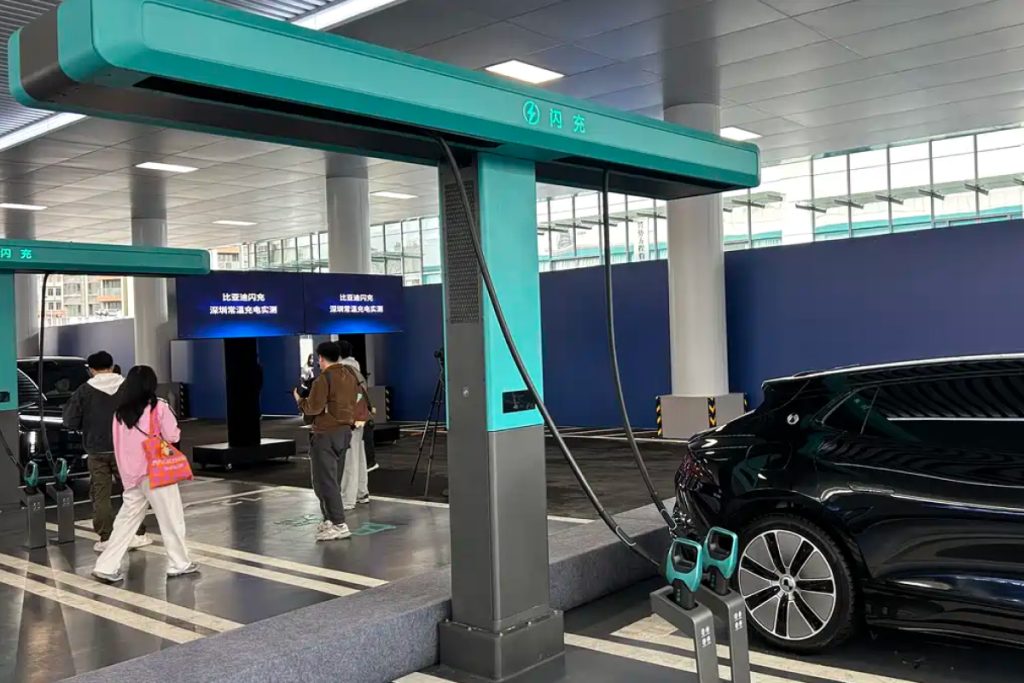
The battery works together with BYD’s newly introduced Flash Charging stations, designed to deliver up to 1,500 kW of charging power at 1,000V. This level of power is significantly higher than most existing fast chargers.
The new charging stations feature:
- A T-shaped charging structure for easier access
- A compact waterproof charging gun
- Sliding rail charging arms that allow vehicles to charge from different positions
Similar to traditional fuel stations, BYD also plans to introduce idle fees to discourage drivers from leaving vehicles connected after charging is complete.
20,000 Flash Charging Stations Planned
To support the new technology, BYD plans to install 20,000 flash charging stations this year, including 18,000 “station-within-a-station” setups.
This innovative approach allows BYD to place its flash charging units inside existing public charging locations, reducing installation costs and accelerating deployment.
According to BYD CEO Wang Chuanfu, the installation process is “as simple as installing an air conditioner.”
In the first two months of the year alone, the company has already completed 4,239 charging stations, which will soon become operational.
Smart Solution to Protect the Power Grid
Ultra-fast charging can put pressure on power grids. To solve this problem, BYD plans to integrate energy storage batteries inside charging stations.
These stations will first charge the storage batteries using existing fast chargers, and then deliver megawatt-level charging to vehicles when needed. This approach helps prevent sudden spikes in electricity demand.
Implications for Nepal
While this technology is currently being deployed in China, it could eventually benefit markets like Nepal, where BYD vehicles are rapidly gaining popularity. Models such as the BYD Atto 3, BYD Atto 2, and BYD Sealion 7 have already become some of the best-selling electric cars in Nepal.
If BYD eventually introduces its flash charging ecosystem globally, it could significantly reduce charging times for EV owners and further accelerate the shift toward electric mobility in Nepal.